Learning notes on physical AGI: from VLAs to world models
What I learned over the Thanksgiving holiday, November 26 to 27, 2026.
I spent the Thanksgiving holiday watching robot learning videos. These are my learning notes on the three I would hand to anyone starting out, with the slides that helped me most. I'm a fan of Love, Death & Robots, and the episode where a cleaning robot turns on its owner, "Automated Customer Service" (Volume 2, Episode 1), is a big part of why I started caring about robots.
1. Jim Fan, "Robotics: The End Game"
Sequoia AI Ascent 2026 · about 20 minutes
Jim Fan leads the embodied AI research group at NVIDIA. His claim is that robotics no longer needs to invent its own roadmap, because language models already wrote one. He calls this the Great Parallel.
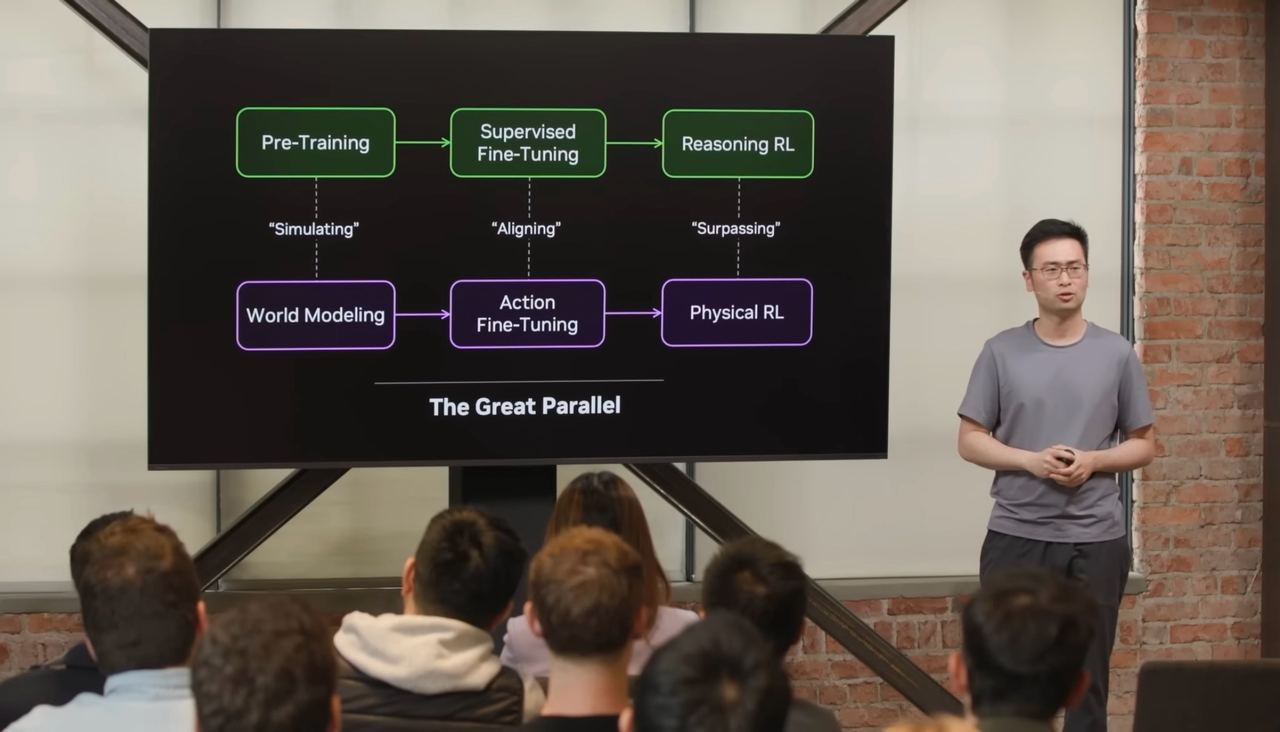
- Pre-training → World modelingA language model learns to predict the next word. A robot model learns to predict the next state of the physical world. The slide labels this step "simulating".
- Supervised fine-tuning → Action fine-tuningA small amount of data with real robot actions turns "I have seen it" into "I can do it". It narrows everything the model can imagine down to the part a real robot can use. The slide labels this "aligning".
- Reasoning RL → Physical RLLanguage models used reinforcement learning to get past imitating people. Robots do the same: try again and again, and adjust by how each try turned out. This covers the last mile, and the slide labels it "surpassing".
Why he says the VLA era is ending
For the past few years the standard robot model has been the VLA, short for vision-language-action. You take a model that already understands images and text, then attach a part on top that outputs robot actions.
Fan's criticism is about where the weight sits. Most of a VLA's parameters serve language, and vision and action come last. The result is a model that is good at nouns, such as naming the cup, and weak at verbs and physics, such as pouring from it.
His replacement is the world action model, or WAM: a model that learns how the physical world moves first, and treats action as a first-class output. That is the "from VLAs to world models" in the title of these notes.
Where robot data comes from
- Teleoperation. A person controls the robot remotely. Every run the robot completes becomes one record. It is accurate and slow.
- UMI. A handheld device with the same gripper as the robot and a camera on top. A person does the task with it, and the motion is recorded without a robot in the room.
- Egocentric video. A person wears a camera and works as usual.
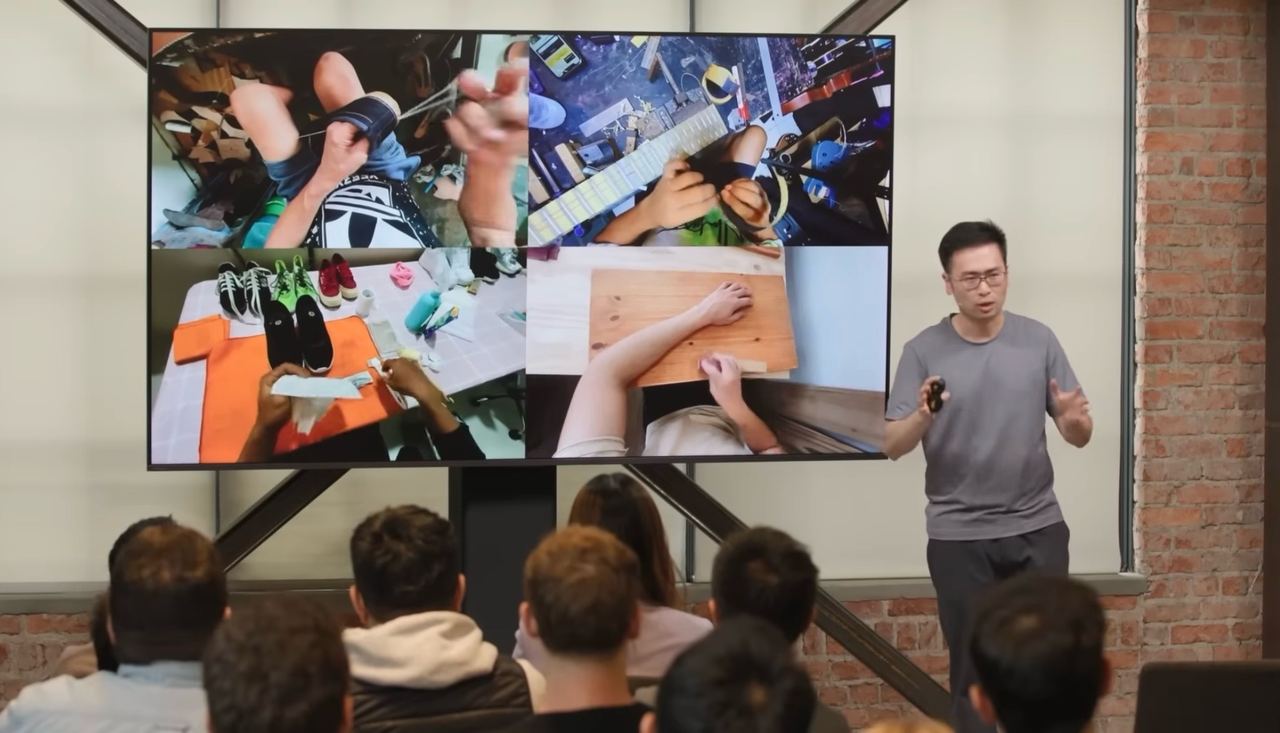
Fan expects the share of teleoperation to shrink to almost nothing within a year or two, with first-person human video becoming the main diet for robot models. And if the real world is too expensive, the robot can train in a generated one.
2. Danfei Xu on WhynotTV
Long-form interview · in Chinese
Danfei Xu is an assistant professor at Georgia Tech who works on robot learning from human data. He did his PhD at Stanford, where Fei-Fei Li was one of his advisors, which makes a nice link to the third talk.
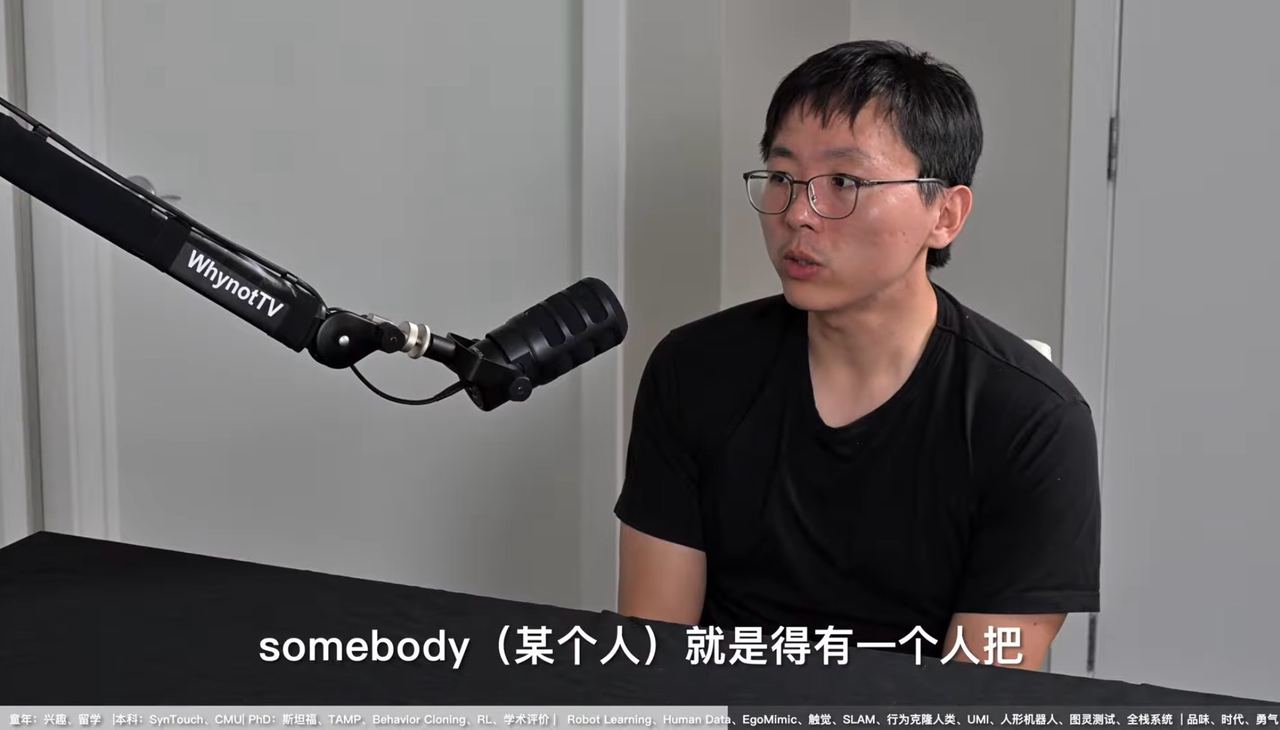
The part I found most useful is how he breaks "a robot dealing with the world" into three questions:
- How should the world change? The cup gets picked up, or pushed forward.
- How does the body make that change happen? To push the cup five centimeters, where do you touch it, and how?
- How does the body produce that motion? How much force does each motor put out? His example is throwing a ball: the joints have to produce enough force, or the ball never follows that path.
The three questions also explain why human video is useful and not enough. Video of a person shows question one very well and question two partly. It says nothing about question three, because a camera does not record force.
He also makes a point about the long run. We should not restrict how people move to suit the robot. The models and the robots should get strong enough to absorb the most natural human data.
3. Fei-Fei Li at CoRL 2026
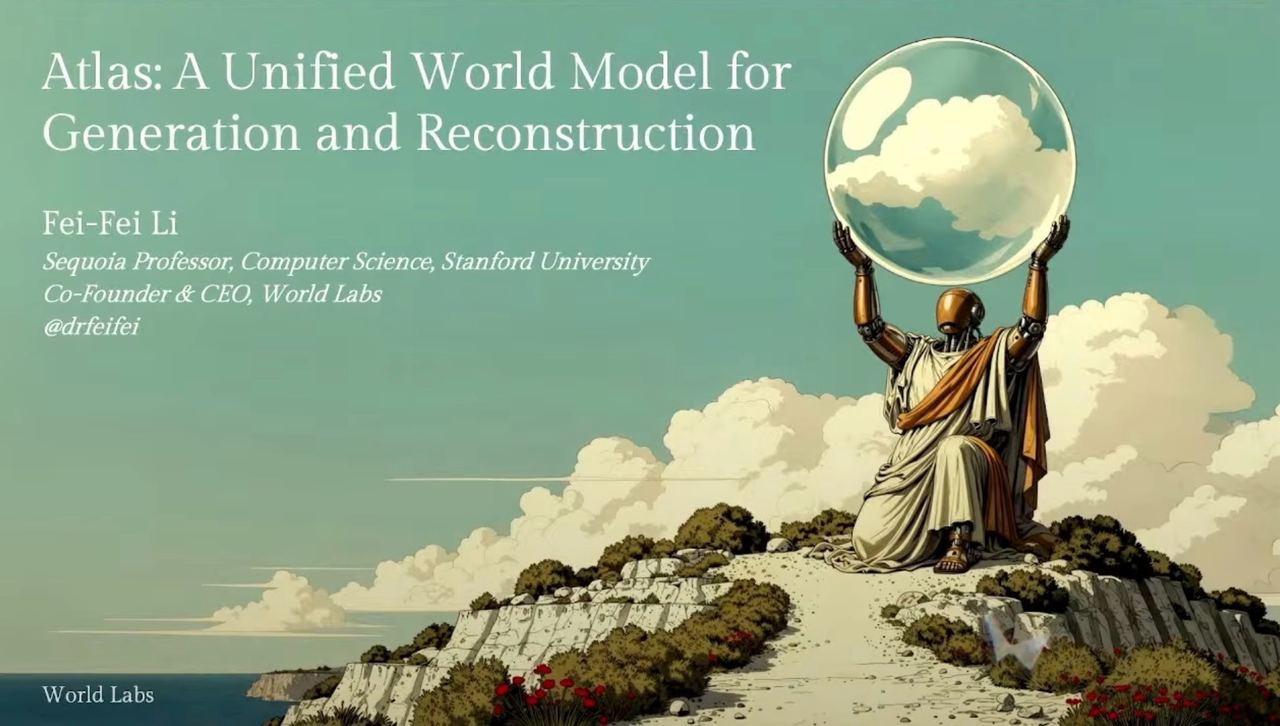
Conference on Robot Learning, Austin · "Atlas: A Unified World Model for Generation and Reconstruction"
She starts from the question every robot has to answer: given the state of the world, a goal, and a body, what should it do next at each moment?
What a world model is. A language model learns what the next word is. A world model learns what the world looks like next.
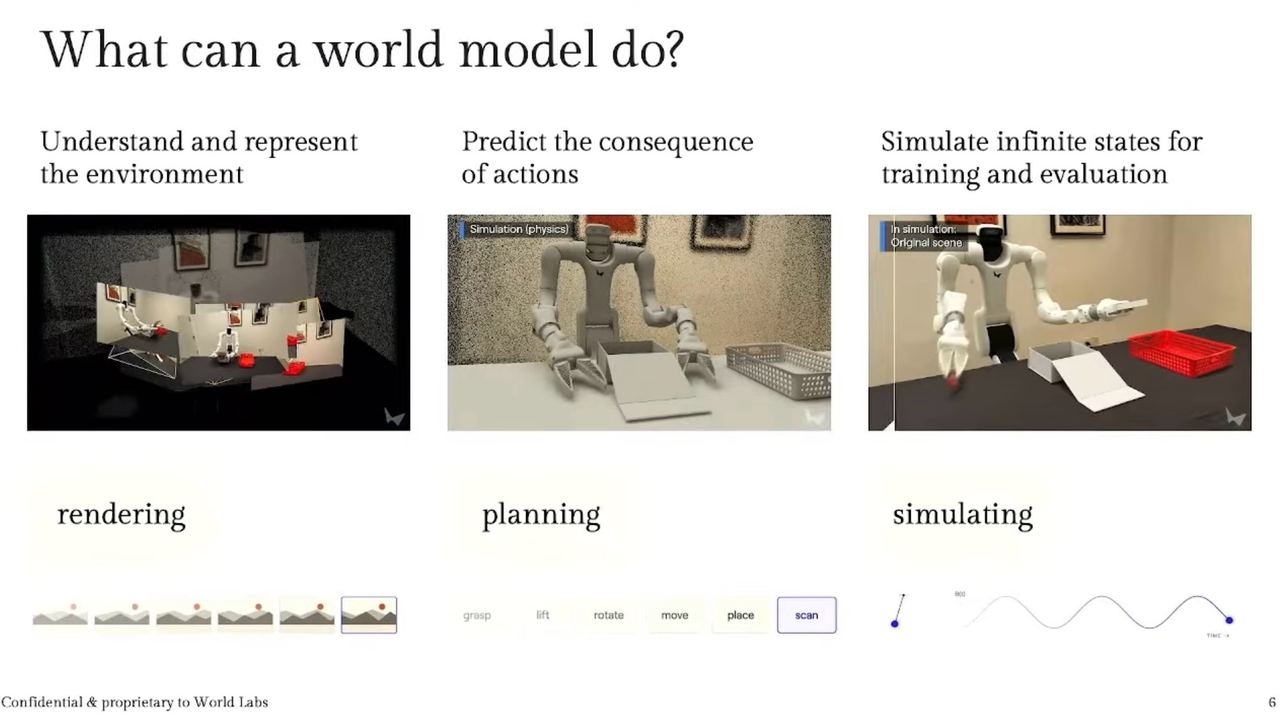
Why robots need one. She gives three uses:
- Representation. The robot has to know what its surroundings look like right now. Her slide calls this rendering.
- Prediction. It has to know the consequence before it acts, or it cannot plan. Her slide calls this planning.
- Data. Situations that rarely happen in real life, and are hard to collect, can be generated for the robot to practice on and be tested on. Her slide calls this simulating.
How Atlas works
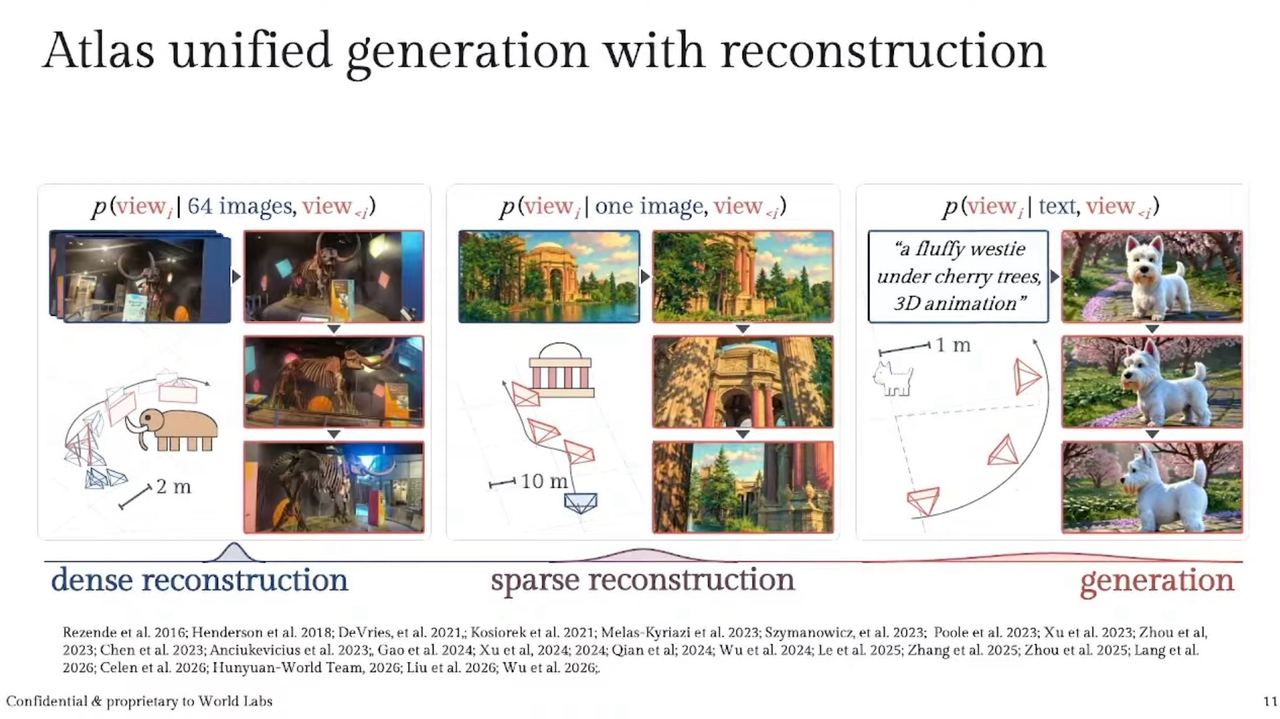
Atlas is the world model from World Labs, released in September 2026. Its main idea is that reconstruction and generation are the same task with different amounts of evidence.
- Many photos of a place. The model has little left to imagine, so it is reconstructing.
- One photo. It has to fill in what it cannot see.
- Only a text prompt. It is generating everything.
In all three cases the model does one thing: predict the next camera viewpoint, given whatever it has seen so far.
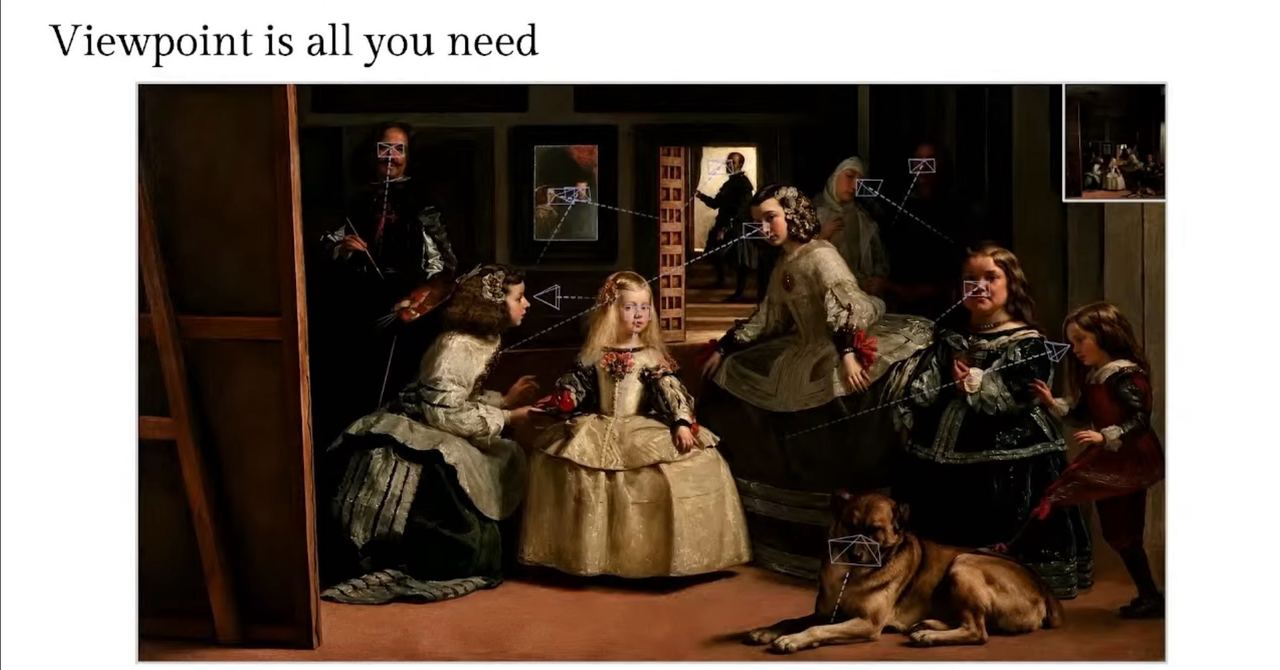
Under the hood, Atlas is a multimodal autoregressive diffusion transformer. In plain words: text and images go into one shared spatial context, and the model produces images, video, and depth one frame after another.
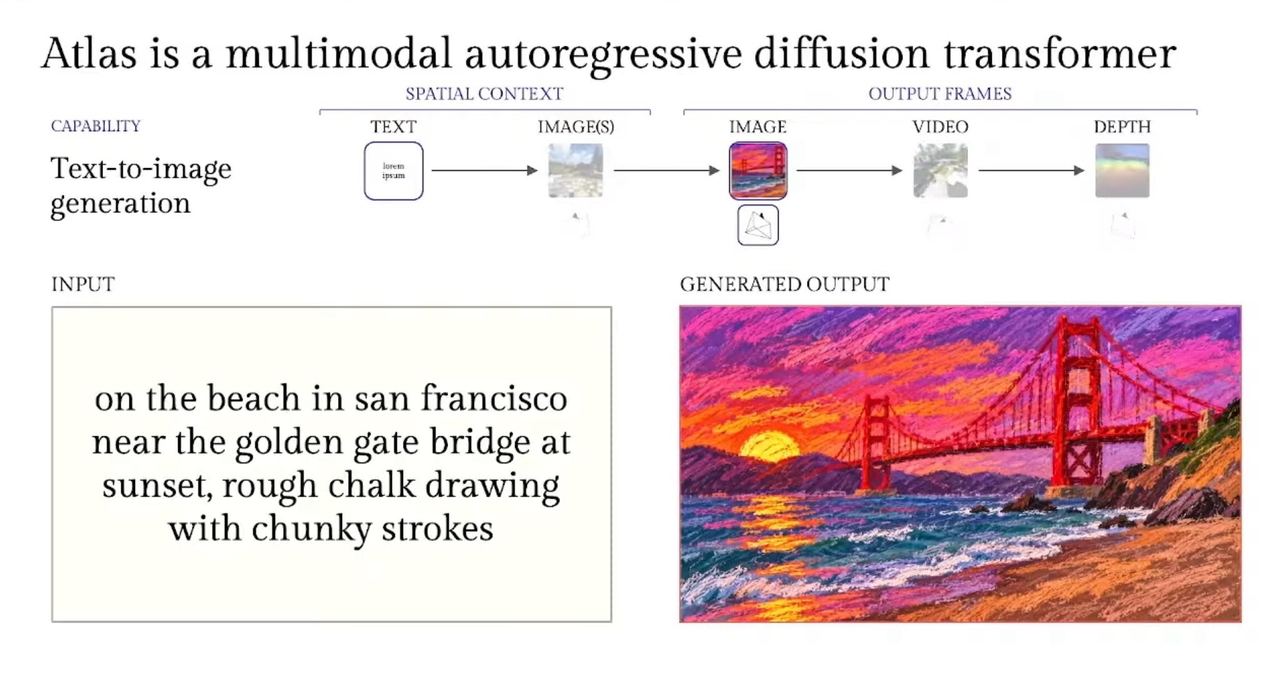
She also showed robots that were trained only in virtual worlds and then used directly in the real one.
What ties the three together
All three talks arrive at the same place from different directions. Fan wants robot models to predict the next state of the physical world. Li builds a model that predicts the next viewpoint. Xu explains what a robot still has to work out once it can see what should happen. The shared bet is that a robot should learn how the world moves before it learns how to move in it.
Glossary
- Physical AGI. General-purpose intelligence that can act in the physical world through a body, such as a robot, and not only on a screen. Physical AI and embodied AI are the more common names for the field today.
- VLA. Vision-language-action model. A vision and language model with an action output attached.
- World model. A model that predicts what the world will look like next.
- WAM. World action model. Fan's name for a model that learns physics and motion first, and outputs actions.
- Teleoperation. A person remotely controls a robot to record demonstrations.
- UMI. Universal Manipulation Interface. A handheld gripper with a camera for recording demonstrations without a robot.
- Egocentric video. First-person video from a camera a person wears.
- Sim-to-real. Training a robot in simulation and using it in the real world.
Sources
- Jim Fan, "Robotics: The End Game", Sequoia AI Ascent 2026. Summary: Humanoids Daily.
- WhynotTV interview with Danfei Xu. His page: faculty.cc.gatech.edu/~danfei.
- Fei-Fei Li, "Atlas: A Unified World Model for Generation and Reconstruction", CoRL 2026. Atlas announcement: worldlabs.ai/blog/atlas.
All screenshots belong to their speakers and are shown here for commentary.